 Ad Access
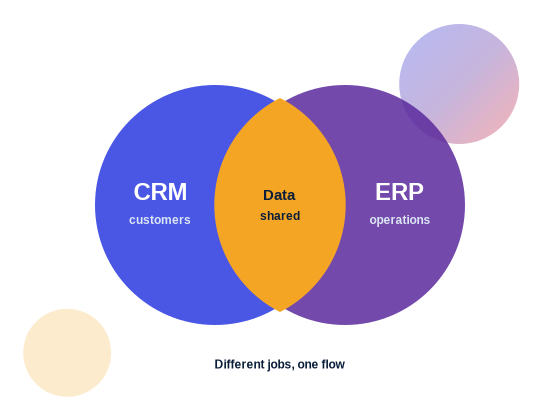

CRM and ERP are often confused, and many companies buy the wrong one first. The short version: a CRM manages your customers and sales. An ERP runs your finance, inventory and operations. Growing companies usually need both, connected.
What a CRM does
A CRM tracks leads, contacts, deals and conversations. It shows your pipeline, reminds people to follow up and reports on sales performance. Its job is to help you win and keep customers.
What an ERP does
An ERP holds the operational record of the business: accounting, purchasing, stock, production and payroll in some cases. Its job is to keep the business running accurately and compliantly.
Which should you start with?
Start with the bottleneck. If deals are lost because follow-up is slow and the pipeline is unclear, start with a CRM. If month-end is painful, stock is wrong or invoices are late, start with finance and ERP processes.
Why connection matters
When the two systems are separate, someone retypes won deals into the ERP and chases payment status by message. Connecting them means a won deal creates the order, and payment status shows up in the sales record.
Where AI fits
AI helps most in the gaps: lead scoring in the CRM, document capture for the ERP, and automated reports across both. You rarely need to replace either system to get the benefit.
A simple decision guide
- Losing deals or leads: CRM first.
- Messy finance, stock or invoicing: ERP processes first.
- Both teams retype each other's data: integration first.
Want this applied to your business?
Book a free 30 minute AI audit and we will look at your own processes.